
The 3 Biggest Toddler Bedtime Mistakes You Didn’t Know You Were Making
Is bedtime with your toddler a constant battle? Learn the 3 biggest toddler bedtime mistakes parents make and how to create a predictable, consistent, calmer bedtime routine.
If bedtime at your house has become a nightly battle of “one more book,” “I need a snack,” “I have to go potty,” “I’m not tired,” “Can we go outside?” and approximately 47 other requests…
Welcome to toddlerhood. 😂
But here’s the thing I want you to know:
Your toddler isn’t necessarily the problem. Your bedtime routine might be.
There are a few very common mistakes I see parents make over and over again when it comes to toddler bedtime. And most of the time, parents aren’t making these mistakes because they’re doing anything wrong on purpose.
They’re tired.
They’re trying to be responsive.
They’re trying to avoid a meltdown.
They’re trying to give their toddler choices.
They’re trying to make bedtime peaceful.
And sometimes, in an effort to make bedtime easier, we accidentally create a routine that makes bedtime harder.
The good news?
These are fixable.
You don’t need to completely overhaul your child’s sleep or turn bedtime into a military operation. You need a few clear boundaries, a predictable routine, and the confidence to actually follow through.
Watch the full video here:
I’m going to walk you through the three biggest toddler bedtime mistakes I see, plus the four-part framework I use to help families create calmer, more predictable bedtimes.
Let’s get into it.
Mistake #1: Your Toddler’s Bedtime Is Too Late
This one is incredibly common.
And I know what you’re thinking.
“But Missy, if I put my toddler to bed earlier, they’re just going to wake up earlier!”
Not necessarily.
In fact, for some toddlers, an earlier bedtime can actually make falling asleep easier because you’re no longer asking an exhausted child to somehow keep themselves together long enough to make it to bedtime.
Toddlers are funny little creatures.
You can have one toddler who takes a nap during the day and happily stays awake until 8:30 or 9:00 PM.
And then you can have another toddler who drops their nap, makes it to 5:30 PM, completely loses their mind, and then somehow manages to fight bedtime until 8:30.
Those are two completely different situations.
What happens when your toddler drops their nap?
Let’s say your toddler used to nap from 1:00 to 2:00 PM.
Their day might have looked something like this:
7:00 AM: Wake
1:00 PM: Nap
2:00 PM: Wake
8:00 PM: Bedtime
That’s a pretty reasonable day for a toddler who still needs that daytime sleep.
But then the nap disappears.
Suddenly, you’re asking your child to stay awake from morning until bedtime.
And if you simply keep the same 8:00 PM bedtime, you’re expecting your toddler to go from having a six-hour-ish wake period after their nap to potentially being awake for 12 hours straight.
Yeah.
I’d be miserable too.
When your toddler stops napping, bedtime often needs to move earlier.
And I’m not talking about moving bedtime earlier by five minutes and then deciding it doesn’t work.
If your toddler has dropped their nap and is melting down by dinner, try moving bedtime significantly earlier. For some toddlers, that may mean getting closer to a 6:30 or 7:00 PM bedtime.
Give the new schedule some time to settle.
But what if my toddler still naps?
That’s where we have to look at the whole picture.
If your toddler is taking a long afternoon nap and then isn’t tired until 8:30 or 9:00 PM, you may need to decide which battle you’re willing to pick.
You may need to:
- Shorten the nap
- Adjust the timing of the nap
- Gradually transition away from the nap
- Accept a later bedtime if your child’s overall sleep needs are being met
There’s no magical bedtime that works for every toddler.
The goal is to look at your child’s sleep needs, nap schedule, wake time, and behavior rather than simply assuming that every toddler needs to be asleep at exactly the same time.
But if your toddler has stopped napping and you’re still expecting them to make it comfortably to a late bedtime?
That’s a red flag I’d look at first.
Mistake #2: Your Toddler’s Bedtime Routine Changes Every Night
This is where things can get really chaotic.
And I want to make something very clear because I talk about toddler independence and autonomy a lot.
I LOVE giving toddlers choices.
But there’s a difference between giving your child appropriate choices and allowing your child to completely run the bedtime routine.
Those are not the same thing.
Your toddler can absolutely have autonomy.
They can choose between the pink pajamas and the dinosaur pajamas.
They can choose which two books you’re reading.
They can choose whether they brush their teeth before or after putting on their pajamas.
They can choose which song you sing.
But you are still the parent.
You are in charge of the order of operations.
Predictability makes toddlers feel secure
Toddlers thrive on knowing what’s coming next.
Think about how many times you’ve seen your toddler insist on doing something exactly the way they’ve done it before.
Same cup.
Same plate.
Same stuffed animal.
Same song.
Same route to preschool.
Toddlers love predictability because it helps them understand their world.
So if Monday’s bedtime routine is:
Bath → pajamas → snack → books → potty → three songs → cuddles → bed
But Tuesday becomes:
Pajamas → outside → snack → another snack → bath → TV → books → potty → another book → bed
And Wednesday is:
“I don’t know. We’re all just trying to survive.”
Your toddler doesn’t have a predictable framework to follow.
They’re going to keep testing.
And honestly?
Why wouldn’t they?
They’ve learned that bedtime is flexible.
Maybe tonight they can get a snack.
Maybe tonight they can get another book.
Maybe tonight Mom will let them watch one more show.
Maybe tonight Dad will take them outside to look at the stars.
Your toddler isn’t necessarily being manipulative.
They’re learning from the environment you’ve created.
The Magic Is Giving Choices Within the Routine
This is one of my favorite toddler parenting concepts:
You’re the boss of the routine. Your toddler is the boss of the choices within the routine.
For example:
You say:
“It’s bedtime. Let’s get your pajamas.”
Your toddler gets to choose:
“Do you want the pink pajamas or the dinosaur pajamas?”
Then:
“It’s time to brush teeth. Do you want to brush first, or do you want me to help you?”
Then:
“It’s book time. Do you want the farm book or the dinosaur book?”
Then:
“It’s time for cuddles. Do you want to cuddle in the rocking chair or on the bed?”
See what’s happening?
The routine doesn’t change.
But your toddler still gets autonomy.
That is the sweet spot.
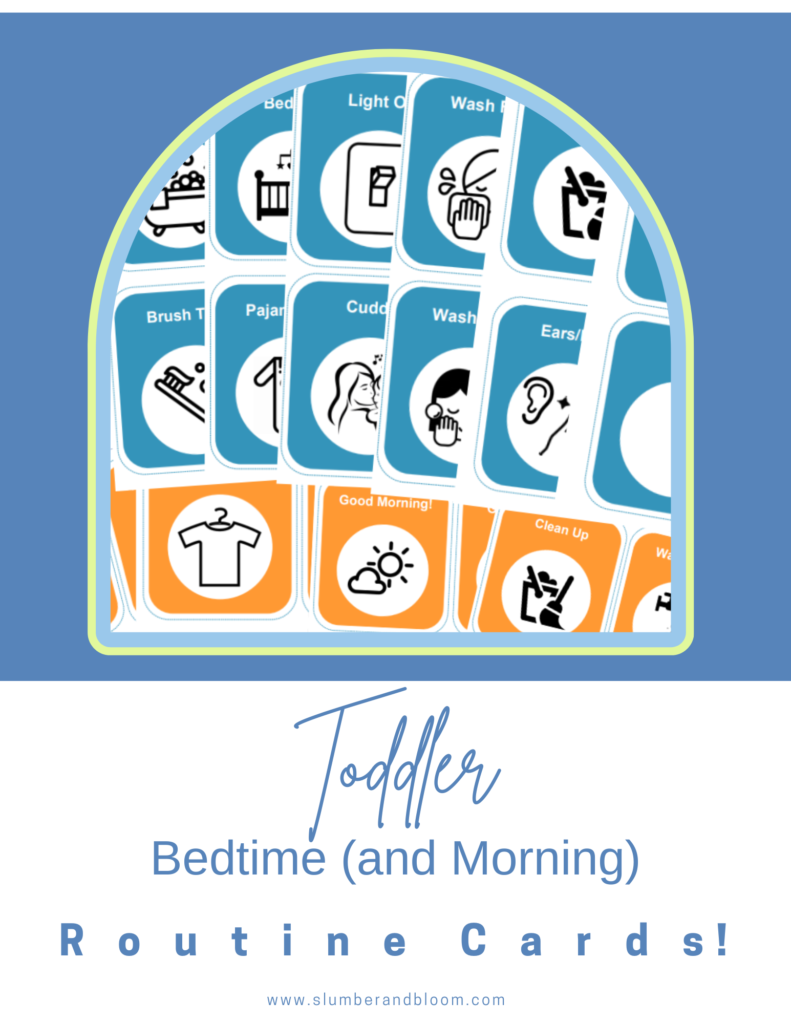
And this is exactly why I love using bedtime routine cards with toddlers.
Bedtime Routine Cards Can Change the Whole Dynamic
Instead of you repeating yourself 15 times:
“Okay, pajamas.”
“Come on, pajamas.”
“It’s time for pajamas.”
“Why aren’t you putting your pajamas on?”
“WE ARE GOING TO BE LATE FOR BED.”
😂
You can point to the visual.
“What’s next?”
Your toddler can see it.
Pajamas.
Brush teeth.
Potty.
Books.
Cuddles.
Bed.
Now your toddler isn’t just being told what to do by Mom or Dad.
They’re learning to participate in the routine themselves.
That’s a huge step toward independence.
And yes, it can take a little time for a toddler to learn how to use the cards and understand the process.
Stick with it.
Don’t introduce them for two nights and then abandon them because your toddler didn’t magically become a bedtime angel.
Give your child time to learn the system.
Grab my free Bedtime Routine Cards
I created a set of free bedtime routine cards specifically to help families make bedtime more predictable and encourage toddler independence.
And because mornings can be just as chaotic, I’m also including morning routine cards as a bonus.
Print them, cut them out, and put them somewhere your child can easily see them.
I recommend using something like removable adhesive or sticky tack rather than tape that might pull paint off your wall. 😉
Mistake #3: You’re Constantly Negotiating With Your Toddler
Ohhhh, this one.
I see it all the time.
And I’m going to lovingly tell you something:
You are allowed to say no.
Your toddler asks:
“Can I have a snack?”
And you think:
Well, maybe they’re hungry.
So you give them a snack.
Then tomorrow night:
“Can I have a snack?”
Now you have a bedtime snack.
Then:
“Can I have another snack?”
Now you’re negotiating about snacks.
Or maybe it’s:
“One more book?”
Sure.
“One more?”
Okay.
“ONE MORE?”
Fine.
“Can you hold me?”
Of course.
“Can you rock me?”
Okay.
“Stay with me.”
Just for a minute.
And suddenly your toddler has turned bedtime into a hostage negotiation.
😂
Stop negotiating the routine.
That doesn’t mean you should ignore legitimate needs.
If your child genuinely needs to use the bathroom, take them to the bathroom.
If they’re genuinely hungry, address it.
If they’re sick, uncomfortable, frightened, or need support, respond to that.
But there’s a difference between meeting your child’s needs and allowing every bedtime request to become a new negotiation.
You are the adult.
You get to say:
“We already read our two books. Tonight we’re all done with books. It’s time for bed.”
And then follow through.
Your toddler may not love your answer.
That’s okay.
A boundary doesn’t have to be popular to be loving.
Bedtime Routine Cards
Visual systems help children with routines. They help make transitions easier while minimizing meltdowns. Having routines encourages healthy habits and will help ease the stress of the morning and nighttime hustle. Instantly download, print and use my bedtime routine cards- with morning routine cards, too!
The Four-Part Framework for a Better Toddler Bedtime
So now that we’ve covered the three mistakes, let’s talk about what you can do instead.
I want you to remember four words:
Predictability
Boringness
Consistency
Confidence
These four things can completely change the tone of bedtime.
1. Predictability
Your toddler should know what’s coming next.
A predictable bedtime routine might look like:
Pajamas → Brush teeth → Potty → Books → Cuddles → Bed
It doesn’t need to be elaborate.
It doesn’t need to take an hour.
It just needs to happen consistently enough that your child begins to recognize the pattern.
That’s where those bedtime routine cards can be so helpful.
2. Boringness
You don’t need to put on a Broadway production every night.
Seriously.
Bedtime doesn’t need to be the most exciting part of your child’s day.
Keep things calm.
Read a couple of books.
Sing a song.
Have some quiet cuddles.
Dim the lights.
Keep your energy calm.
And then it’s time for bed.
Boring is good.
Your toddler doesn’t need a new adventure at 7:45 PM.
They need their brain and body to understand:
The day is winding down. Sleep is coming.
3. Consistency
This is the big one.
And consistency isn’t just a toddler sleep strategy.
It’s a parenting skill you’re going to use for years.
Today it’s:
“It’s time to brush your teeth.”
Tomorrow it’s:
“It’s time to clean your room.”
Eventually it’s:
“It’s time to vacuum the living room.”
And you want your child to learn that when you establish a routine or expectation, you mean what you say.
That doesn’t mean being harsh.
It doesn’t mean being rigid.
It means being predictable.
Your child knows what to expect from you.
And you know what to expect from them.
That’s powerful.
4. Confidence
This might be the piece parents overlook the most.
Your toddler can feel your energy.
If you’re standing outside their bedroom saying:
“Okay… are you ready for bed? Do you want to brush your teeth? Do you want to put your pajamas on? Are you sure? What do you want to do?”
Your toddler is getting the message that bedtime is up for discussion.
Instead, try:
“It’s bedtime! Let’s get your pajamas. Do you want the pink ones or the dinosaur ones?”
See the difference?
You’re confident about what is happening, while still giving your child a choice about how it happens.
That’s the sweet spot.
Your Toddler Doesn’t Need to Run the Bedtime Routine
Your toddler can have independence without being in charge.
They can make choices without making all the decisions.
They can have autonomy while still having boundaries.
And they can be upset about a boundary without that boundary being wrong.
That’s an important distinction.
Your job isn’t to make your toddler happy every second of the bedtime routine.
Your job is to lovingly lead them through it.
And when you have a predictable, boring, consistent routine and you confidently follow through, bedtime becomes much easier to understand.
And This Isn’t Just About Your Toddler’s Sleep
This is something I really want parents to think about.
On my client intake forms, I ask parents:
“Once your child’s sleep improves, what is one thing you want to get back to doing for yourself?”
And the answers are always so telling.
Parents want to:
Spend more time with their partner.
Work out.
Take care of themselves.
Get more sleep.
Have an evening to themselves.
Watch a show without being interrupted.
Read a book.
Simply sit down.
Your toddler’s sleep isn’t just about whether your child sleeps through the night.
It’s about what happens to your entire family when everyone is getting the rest they need.
When you’re constantly exhausted, constantly negotiating, constantly battling bedtime, and constantly wondering what you’re doing wrong, it affects you too.
You deserve to feel confident in your parenting.
You deserve to have your evenings back.
And your toddler deserves a bedtime routine that feels safe, predictable, and manageable.
Ready to End the Toddler Bedtime Battles?
If you’re reading this thinking:
“Okay, Missy… but I’ve already tried all of this and my toddler is STILL fighting bedtime.”
That’s where I come in.
Sometimes you don’t need another generic sleep tip.
You need someone to look at your child’s specific schedule, sleep needs, bedtime routine, behaviors, and your family’s goals and help you figure out what needs to change.
That’s exactly what I do inside my personalized toddler sleep consultations.
BOOK A TODDLER SLEEP CONSULTATION
We’ll look at what’s actually happening, identify the roadblocks, and create a plan that fits your child and your parenting style.
Because there is no prize for making bedtime harder than it needs to be.
You don’t need to spend every night negotiating with a tiny human who suddenly needs 14 things between pajamas and lights out.
You can lead.
You can set boundaries.
You can give your toddler choices.
You can support their independence.
And you can still be incredibly responsive and loving.
Predictability. Boringness. Consistency. Confidence.
Start there.
And then watch what happens.
Keep blooming. 💕